
Generational renewal in the furniture industry: what to look for in a manufacturer.
Generational renewal is already affecting manufacturing capacity. Here are five questions to help you assess whether a furniture manufacturer can reliably deliver your project.
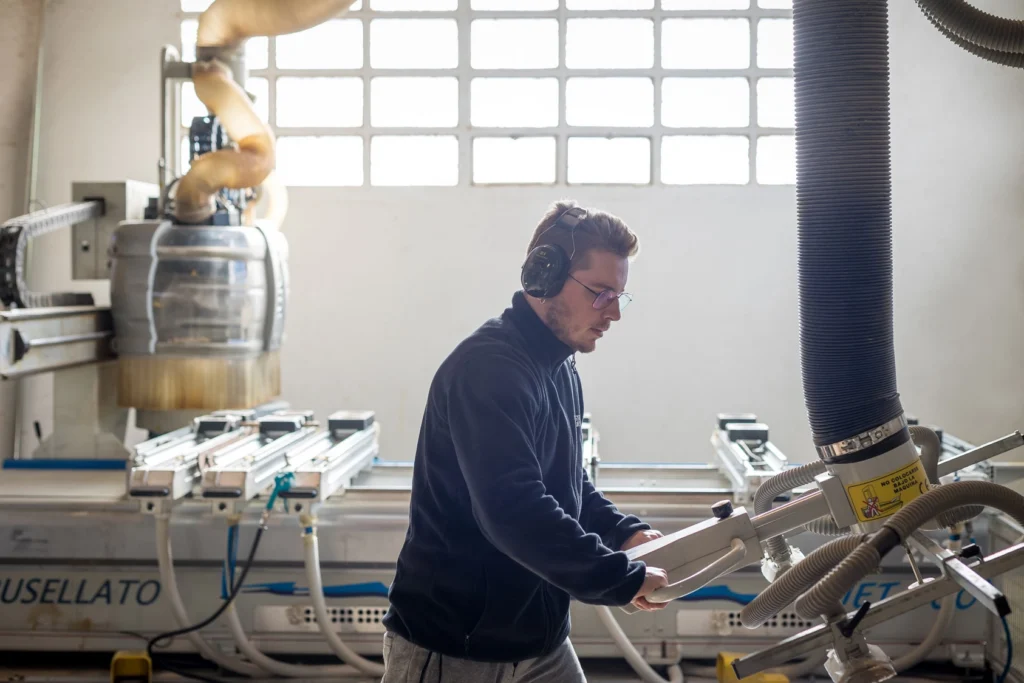
A bespoke furniture project can take weeks to define and months to manufacture. The process relies on people who have spent years mastering a craft that cannot be fully captured in a technical drawing. When an experienced worker retires and no one takes over their role, the impact becomes visible in lead times, consistency and the ability to respond to change.
Generational renewal is often treated as an internal business issue. For companies that outsource manufacturing, however, it is also a supplier risk factor. In this article, we examine the available data and the questions worth asking before committing to a project.
What does the data tell us? An industry-wide challenge
A study by CaixaBank Dualiza and Orkestra (Basque Institute of Competitiveness), published in April 2026, identifies manufacturing as one of the sectors most exposed to this challenge. Its workforce is older than the labour market average, and it relies on technical profiles that are difficult to replace at short notice.
Which figures matter most to customers?
In 2025, almost every Spanish autonomous community had an insufficient replacement rate in manufacturing. More workers were approaching retirement than young people were entering the sector.
The study estimates around 1.5 million employment opportunities by 2035, driven mainly by the need to replace retiring workers.
Intermediate-level vocational education, essential for operations, maintenance and production, is not supplying enough new workers to offset these departures.
Almost two-thirds of graduates in industrial vocational training are concentrated in Electricity and Electronics, Transport and Vehicle Maintenance, and Mechanical Manufacturing. Wood-related training accounts for one of the smallest groups of students.
The study covers manufacturing as a whole. Within the furniture industry, however, FIMMA + Maderalia, as part of the trade fair taking place at Feria Valencia in November 2026, has also identified the shortage of newly qualified professionals as one of the main constraints on growth in the wood and furniture sectors.
Why does this matter to companies commissioning furniture?
Knowledge that never makes it onto a drawing
A technical drawing specifies dimensions, materials and fittings. It does not explain how to set up a machine for a production run, in what order components should be assembled to ensure everything fits correctly, or how to respond when a batch of boards arrives with dimensional variations.
This knowledge comes from the practical judgement of experienced workshop staff. If it is not passed on, it leaves with them.
Where the impact becomes visible first
Lead times: when only one person knows how to perform a critical task, that role becomes a bottleneck. If they are unavailable, production can stop.
Repeatability: in long production runs, replacing someone who knows exactly which adjustments ensure that unit 500 matches unit 1 is not straightforward.
On-site response: last-minute changes are easier to manage when people understand the entire process, rather than just their own role.
A risk that does not appear in the quotation
The unit price does not reveal how dependent a manufacturer is on key individuals. Two manufacturers can submit identical quotations while carrying very different levels of operational risk. That difference often becomes apparent halfway through production.
Five questions to assess a manufacturer's long-term continuity
How many people are proficient in each critical process?
If the answer is one, there is a dependency worth understanding before signing the contract.How is knowledge transferred?
Documented processes, product-specific technical sheets and a proper handover period for new employees make a significant difference compared with relying on the assumption that things have always been done a certain way.Are younger workers joining the company, and in which roles?
Production roles matter, not just administrative positions. Collaboration with vocational training centres is a tangible sign of investment in future skills.Which parts of the project depend on a single machine or person?
Ask this question at every stage: cutting, machining, assembly, finishing and dispatch.What happens to your project if a key person becomes unavailable halfway through production?
A manufacturer with genuine operational capacity should be able to explain specific processes and practical alternatives, rather than offering vague assurances.
The best way to verify the answers is to speak with the person responsible for production and visit the factory, rather than relying solely on the person presenting the quotation.
What can companies outsourcing manufacturing do?
Share forecasts in advance. A manufacturer with early visibility of annual production runs can plan staffing, equipment and training. An order that arrives with little notice must be accommodated using whatever resources are available.
Assess the underlying structure. Workforce size, the range of in-house processes and experience in the industry reveal more about a manufacturer’s ability to absorb unexpected changes than a unit price alone.
Build long-term relationships. Suppliers with stable, ongoing partnerships have greater incentives to invest in their teams than those receiving occasional orders.
A conversation that also concerns us
Bustper has been manufacturing in La Sénia, Tarragona, since 1973. We have a team of more than 75 people and 15,000 m² of production facilities. We work as an external manufacturing partner for brands that need additional production capacity, interior design studios, architecture practices and FF&E companies.
Companies that outsource manufacturing also depend on the strength and continuity of their manufacturer’s workforce. These are questions any customer can ask us — and should feel comfortable asking.
If you are looking for a manufacturer for a contract furniture project or a production run, get in touch and we will review your requirements together.
FAQ
What is generational renewal in the manufacturing industry?
It is the replacement of retiring workers by younger professionals with the necessary training and skills. A succession gap arises when more people leave the workforce than enter it, or when incoming workers lack the technical skills being lost.
Does it affect bespoke furniture manufacturing?
Yes. The sector relies heavily on experienced technical professionals whose work combines machinery operation with practical craftsmanship. The available data covers manufacturing as a whole, while the wood and furniture sector has also identified the shortage of new professionals as a constraint on growth.
How can I tell whether a manufacturer has the capacity to maintain production over time?
Ask about team versatility, documented processes, the recruitment of younger workers and dependencies on specific machines or individuals at each stage of your project. If possible, visit the factory.
What training is available for the wood and furniture industry?
Vocational education includes the Wood, Furniture and Cork specialism, with dual training options available in part of the programme. It is a key route for bringing new technical professionals into manufacturing workshops.
Do you have a furniture project underway?
At Bustper, we work across two complementary areas: product development and manufacturing for contract projects, and industrial manufacturing for brands looking for a reliable production partner.
Tell us what you need, and we will assess how we can help.